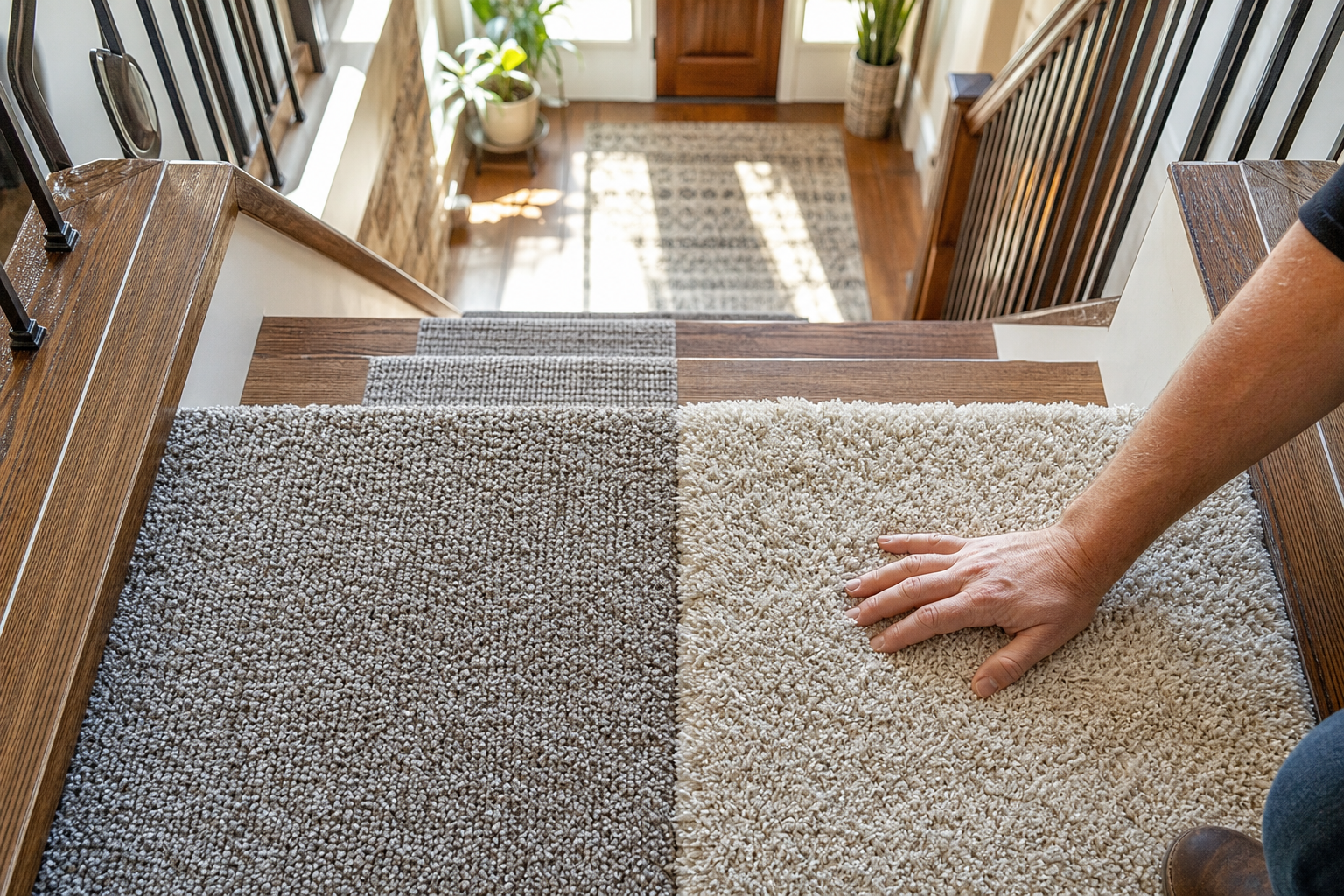
Soft carpet feels nice in your hand. On a staircase, that is not the first test that matters. The best carpet for staircases is the one that helps your family keep footing, takes daily traffic without crushing flat, and still looks respectable after kids, cats, guests, and grocery runs up and down the steps in Colorado Springs.
The best carpet for staircases is usually a low, dense pile carpet with strong construction and good traction underfoot, often a textured cut pile or a tight, low-profile loop made from durable nylon. For busy family homes in Colorado Springs, safety and wear matter more than softness alone, because tall plush styles and loose loops can feel slippery, mat down faster, and wear poorly on stair edges.
Myth: The softest carpet is the best carpet for staircases because stairs should feel cushioned and comfortable.
Reality: On stairs, too much softness can work against you. A carpet that is too tall, fluffy, or loose underfoot can reduce stable footing and show wear quickly on the nose of each step. I tell homeowners to judge stair carpet by security first, then comfort.
What is the best carpet for staircases?
The best carpet for staircases is a low, dense, durable carpet that feels secure underfoot and resists crushing on the front edge of each tread. In most Colorado Springs homes, that means a tightly built carpet in nylon or a similarly durable fiber, paired with the right pad and a careful stair installation.
That answer is simpler than the showroom names make it sound. Stairs are one of the hardest places in the house for carpet because every footstep lands in a narrow path, and much of that force hits the stair edge. The Centers for Disease Control and Prevention notes that falls are a major source of injury in the home, which is one reason I never treat stair carpet like a style-only decision.
In real family houses around Colorado Springs, Monument, Falcon, Fountain, and Security-Widefield, the common complaint is the same. The old carpet got slick, matted, or worn on the edges long before the rest of the home did. That is why the best carpet for staircases should be chosen by these 3 tests first:
- Low, dense pile. Less shifting underfoot, better footing, less visible crushing.
- Strong construction. Better resistance to traffic, especially on stair noses.
- Traction. A surface your foot can read and hold onto, not one that slides.
I have been doing this more than 40 years, and stairs are where bad carpet choices show themselves fastest.
What makes carpet work well on stairs?
Carpet works well on stairs when it stays firm underfoot, bends cleanly over each step, and resists flattening in the middle walking lane. The right stair carpet should support safe footing and hold its appearance where wear is concentrated, not just feel soft in a sample board.
| Stair Carpet Criterion | Stronger Choice | Weaker Choice |
|---|---|---|
| Pile height | Low to medium-low pile | Tall plush or shag-like pile |
| Density | Tight, compact face yarn | Loose, airy construction |
| Surface feel | Textured, stable footing | Slick, silky surface |
| Construction | Textured cut pile or tight loop | Loose loop or delicate pattern loop |
| Wear on stair edge | Holds shape longer | Crushes and fuzzes faster |
The practical features that matter most are not glamorous, but they are what keep a staircase performing:
- Density over fluff. Dense carpet supports the foot better and shows less crushing.
- Shorter pile over taller pile. Lower profile usually means better stability.
- Clear pattern of traffic resistance. Stairs are not a low-use area. Treat them like a hallway turned vertical.
- A finish that hides use. Texture helps disguise footprints, traffic lanes, and cat fur better than smooth formal plush.
Colorado Springs staircases get extra abuse from dry air, tracked-in grit, and winter snowmelt brought in from entryways. In El Paso County homes, I often see stair carpet fail faster because abrasive dust and fine gravel work into the pile long before homeowners think the stairs are the problem area.
Which carpet styles and fibers tend to be the best carpet for staircases?
The best-performing stair carpets are usually textured cut pile carpets and some tight, low-profile loop styles, with nylon often leading the pack for durability. The goal is not the fanciest label. It is a carpet style and fiber that can take repeated foot traffic without turning slick, crushed, or ragged.
Are textured cut pile carpets good for stairs?
Yes. Textured cut pile is often one of the safest all-around choices for family staircases because it combines a softer feel with a more stable, lower profile surface. It also tends to hide traffic marks better than formal saxony or velvet styles.
This is a strong fit for busy Colorado Springs homes with kids and multiple cats because the texture helps disguise wear and fur. Many homeowners want soft carpet on the stairs and upstairs hall, and this style usually gives the best balance.
Are loop carpets good for stairs?
Sometimes. Tight, low loops can perform well on stairs, but loose loops are a poor bet in many family homes. The safer pick is a compact loop with a low profile, not a casual oversized loop with a lot of movement.
If you have cats, be extra cautious. Loops can snag. That does not mean every loop carpet is wrong, but it does mean the construction needs a hard look before it goes on stairs.
Which carpet fiber holds up best on stairs?
Nylon is usually the best fiber choice for stair durability because it is resilient, springy, and proven in high-traffic areas. Polyester can feel soft and look good, but on heavily used stairs it often does not rebound as well as nylon.
The Carpet and Rug Institute identifies nylon as a fiber known for resilience and performance in demanding spaces. In plain terms, that matters on stairs because crushed fiber is what makes steps start looking tired fast. I have seen nylon stair carpet in active homes still holding its shape years after softer-looking alternatives gave up.
"On stairs, I would rather put you in a carpet that feels a little firmer on day one and still looks good years later, than something silky that starts laying down in the first traffic lane." , John Hughes
What should you avoid on busy household stairs?
You should avoid tall plush carpet, very silky finishes, and loose loop styles on stairs if safety and wear are the priority. These styles may look inviting in a bedroom, but on steps they can flatten, feel slick, or wear unevenly much sooner.
Common mistake: choosing stair carpet by hand-feel alone
A sample can feel wonderful between your fingers and still be the wrong carpet for a staircase. The weak choice is a tall, soft plush that feels luxurious on the board. The stronger choice is a lower, denser carpet that gives your foot better contact and keeps its structure on the stair nose.
Here is what I would usually steer away from for a high-traffic staircase:
- Tall plush or deep frieze styles. Too much movement underfoot, harder to keep looking clean.
- Loose, chunky loops. More prone to snagging and wear issues.
- Very shiny or silky finishes. Can feel slicker and show tracking.
- Low-grade builder carpet on a main staircase. Stairs are not the place to cut performance.
That does not mean every soft carpet is bad. It means stairs punish the wrong softness. If the staircase in your Fountain or Falcon home is your main route 20, 30, or 40 times a day, the wrong style will tell on itself quickly.
If you are weighing carpet against hard surface on nearby areas, it helps to compare those wear questions honestly. We cover that same real-household thinking in pieces like best vinyl plank flooring in Colorado Springs and how laminate handles a Colorado Springs entryway, because local traffic and weather change what performs well.
How do padding and installation affect stair performance?
Padding and installation matter almost as much as the carpet itself on stairs. A pad that is too thick can make the step feel unstable, and poor installation can lead to premature wear, wrinkling, or a loose feel right where you need secure footing most.
The right stair pad is usually firmer and thinner than what some homeowners expect. Too much cushion can create extra movement, especially on the front edge of the step. On stairs, more softness is not automatically better.
Good stair installation should include:
- Accurate measurement of each tread and riser.
- Clean, secure fastening so the carpet stays tight.
- Proper handling around the stair nose, where wear is heaviest.
- Pad selection matched to staircase use, not just showroom comfort.
The National Fire Protection Association reports that falls on stairs remain a significant home safety issue. Carpet alone does not solve that, but the wrong pad or loose installation can make a bad situation worse.
This is where homeowners sometimes learn the hard way that product and installation should be discussed together. If you want the behind-the-scenes side of that process, our article on what full service flooring means for Colorado Springs homes explains why measuring, prep, and install details matter long after shopping day.
I have seen stair jobs where the carpet itself was decent, but the pad was too spongy and the fit over the noses was sloppy. That is not a product problem anymore. That is an installation problem.
How should Colorado Springs homeowners choose stair carpet for real family use?
Colorado Springs homeowners should choose stair carpet by matching the staircase to the people and pets who use it every day. The best answer usually comes from traffic, footing, maintenance, and pet realities, not from the softest display in the store.
For a busy household, I suggest narrowing your decision with this checklist:
Stair carpet checklist for Colorado Springs families
- Choose a low, dense pile.
- Favor nylon if the stairs get heavy daily use.
- Look for texture that hides traffic and fur.
- Avoid loose loops if you have cats that may snag them.
- Ask for a stair-appropriate pad, not the thickest pad available.
- Make sure the installer measures and fits the stairs carefully.
- Test samples on an actual step in socks and shoes.
If the staircase ties into an upstairs carpet replacement, plan the project around real logistics too. Homeowners often ask how long installation takes, whether old carpet is removed, and whether they need to move furniture first. Those details matter, especially mid-project, and our guide on moving furniture before new flooring is installed can help you plan the day realistically.
For some families, the best carpet for staircases is not the same as the best carpet for a quiet guest room. That is normal. Stairs are a performance zone. Treat them that way and you usually end up happier with the result.
The best carpet for staircases is the one that stays secure, wears evenly, and fits how your household really lives. In my experience, most regrets come from choosing by softness first and construction second. Flip that order, and you make a better stair decision.
Need help choosing the best carpet for staircases?
If your stairs in Colorado Springs, Monument, Falcon, Fountain, or Security-Widefield are worn, slick, or just hard to judge from samples alone, we can help you compare the right low-pile, durable options in your own home and on your own steps. Book a free in-home flooring measure and consultation with O'Briens Carpet One Floor & Home at .
Schedule your free in-home stair carpet consultation