A flooring install moves fastest in an empty room. In a lived-in Colorado Springs home, the job changes the minute the crew has to work around beds, sectionals, TVs, desks, or a refrigerator. That is why so many homeowners ask the same thing right before scheduling: do I need to move furniture for flooring installation, or do floor installers move furniture for me?
Usually, yes. Homeowners often need to move at least some furniture before new flooring is installed, unless the written estimate or scope says the installer will move specific items. Some flooring companies move basic furniture, some move only certain pieces, and some do not move furniture at all. Get the answer room by room, and get it in writing before installation day.
Do homeowners need to move their furniture before new flooring is installed?
Yes, in many cases they do. The real answer depends on what your flooring company agreed to move, what type of furniture is in the room, and whether the project is one empty room or a whole occupied home.
That directly answers the searches I hear all the time: do floor installers move furniture, do flooring companies move furniture, will flooring installers move furniture, and will flooring companies move furniture. Sometimes yes. Often partially. Never assume.
If the responsibility is not spelled out in writing, installation day can start with confusion instead of progress. I have seen plenty of homeowners do a good job choosing carpet, hardwood, laminate, tile, or LVP, then leave the room-prep question until the last 24 hours. That is where schedules get sideways.
An empty room gives the crew clear access to:
- Remove old flooring
- Inspect and prep the subfloor
- Bring in materials and tools safely
- Install without stopping to shuffle contents around
- Finish on the expected timeline more easily
A furnished room creates a different job. Now the crew may need to shift items into a hallway, a finished room, a garage, or one side of the space and install in phases. That adds labor, adds time, and can change the order of the rooms.
I have been in flooring for over 40 years, and this is one of the biggest schedule changers I see. Furniture is not a side issue. In an occupied home, it is part of the install plan.
Do floor installers move furniture, or is that the homeowner's job?
Some installers move some furniture, but many have limits. Basic chairs, small tables, and lighter pieces may be included. Heavy, fragile, oversized, electronic, or specialty items often are not.
This is why broad promises like “furniture moving included” are not enough. Included can mean very different things from one company to the next.
Here is the simplest breakdown.
| Item Type | Often Moved by Flooring Crew? | What Should Be Confirmed |
|---|---|---|
| Dining chairs, small tables, nightstands | Often, yes | Whether labor is included or billed separately |
| Sofas, dressers, standard beds | Sometimes | Weight limits, room access, phased moving plan |
| Adjustable beds, bunk beds, large sectionals | Often limited | Disassembly, liability, extra labor needed |
| TVs, desktop computers, monitors, sound systems | Usually no | Who disconnects and reconnects them |
| Refrigerators, washers, dryers | Sometimes | Hookups, shutoff valves, reconnection policy |
| Pianos, safes, aquariums, pool tables | Usually no | Need for specialty movers |
The Occupational Safety and Health Administration sets workplace safety guidance around lifting, material handling, and jobsite hazards. That is one reason flooring companies often place limits on what crews will move, especially with very heavy pieces, appliances, or anything fragile.
My plain advice is simple. If you have to ask twice whether a crew will move a certain item, it needs to be named in writing.
Why does furniture planning change labor, room access, and the installation schedule?
Furniture planning changes the schedule because a crew can work straight through an empty room, while a furnished room creates stop-and-start staging. That affects labor hours, daily access, room order, and how many spaces can realistically be completed in 1 day, 2 days, or 4 days.
Strong planning sounds like this: “Guest room will be fully emptied the night before. Main bedroom furniture will be moved by homeowner except the king headboard and frame, which installer will move if scope allows. Office monitors and printers will be disconnected by homeowner.”
Weak planning sounds like this: “We will just move stuff around as needed.”
The weak version is where the first hour disappears.
In Colorado Springs, that matters even more because many families stay in the house during the project. People are still getting kids to school, logging into work, letting dogs out, and using packed garages for storage. A three-room project in an occupied house is not the same job as three empty rooms, even with the exact same flooring product.
Here in Colorado Springs and across El Paso County, I see this become more complicated during snow season and summer move season. In neighborhoods like Briargate, Falcon, Fountain, and Monument, garages are often already packed with bins, sports gear, or moving boxes. If there is no temporary staging space, the crew has fewer options and the job slows down fast.
Clear access paths matter for another local reason too. Snowmelt, gravel, and de-icing residue get tracked through entryways in winter and early spring. If the install path is tight and the house is still fully furnished, that extra traffic becomes harder to manage.
If you are trying to compare what a more complete installation process should look like, our article on what full service flooring means for Colorado Springs homes helps explain what should be handled before, during, and after install day.
What should be listed in the written project scope before installation day?
The written scope should list exactly who moves what. That includes furniture, beds, electronics, appliances, fragile objects, closet contents, and oversized pieces.
This is the part homeowners skip because they think the answer is obvious. It is not obvious once a king bed, 2 dressers, 3 monitors, a washer, and a dog crate are all in the same work zone.
Ask for these categories to be addressed:
- Standard furniture. Sofas, chairs, end tables, coffee tables, dressers
- Beds. Mattresses, bed frames, adjustable bases, platform beds, bunk beds
- Appliances. Refrigerators, laundry units, ranges, wine fridges
- Electronics. TVs, sound bars, printers, desktop computers, monitors
- Fragile items. Lamps, art, mirrors, glass shelving, collectibles
- Closets. Shoes, hanging clothes, bins, loose storage
- Specialty items. Pianos, safes, aquariums, gym equipment
- Reset expectations. Whether items are returned the same day, next day, or after cure time if needed
Pre-installation responsibility checklist
- List every room being installed, 1 by 1
- Mark each room as empty, partially furnished, or occupied
- Name who moves furniture in each room
- Confirm who disconnects TVs, computers, and internet equipment
- Confirm appliance policy and whether hookups are touched
- Identify anything that needs a specialty mover
- Remove fragile items before the crew arrives
- Decide where staged furniture will go during each phase
If you are shopping products at the same time, prep questions often overlap with durability questions. For busy households, our article on Lyrus flooring for busy homes with pets and kids is useful because the best product on paper still has to fit the way your house actually functions during install and after.
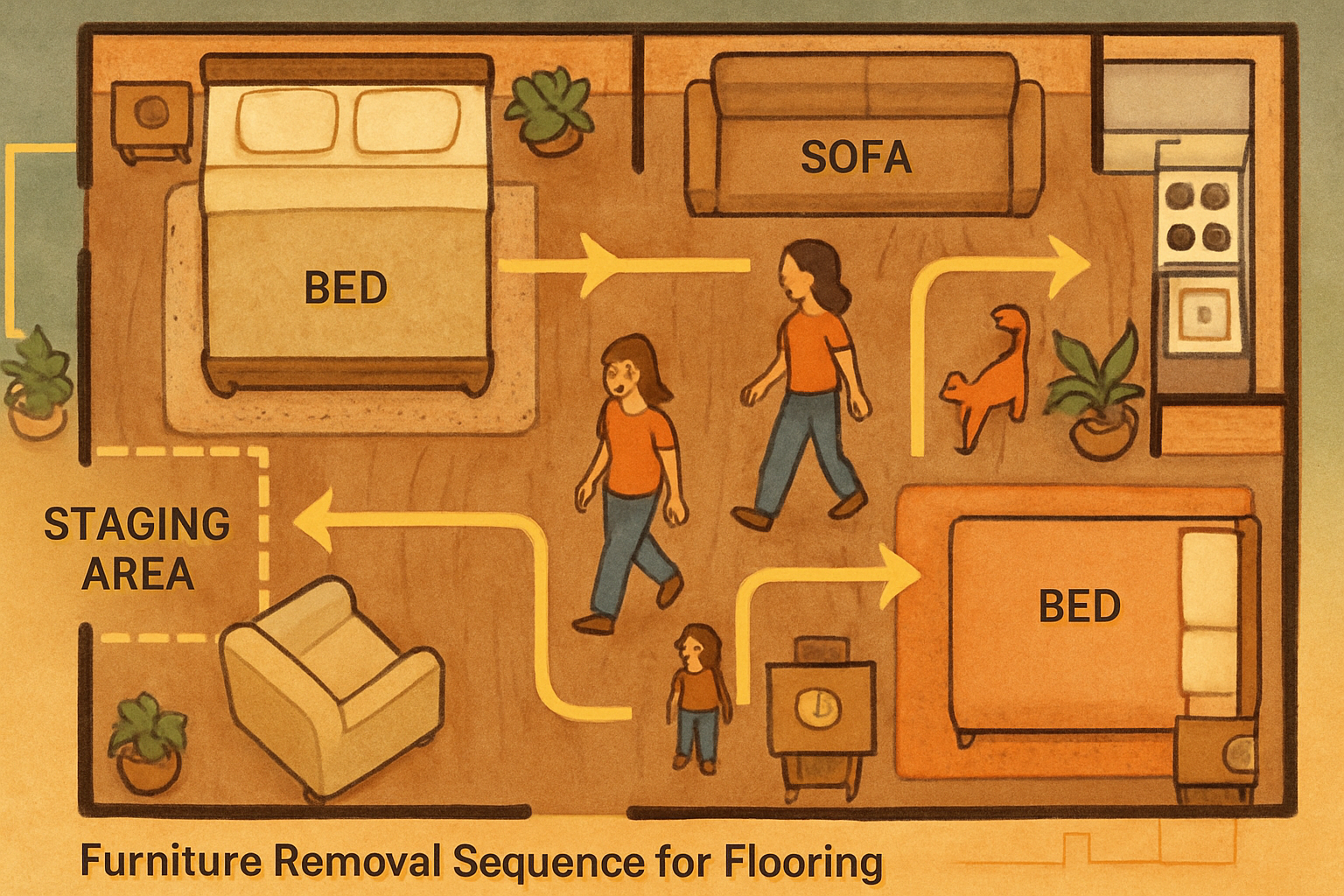
How does staged furniture movement work in a lived-in multiroom remodel?
Staged furniture movement means the contents are relocated in phases so the crew can keep working through an occupied home. It can work well, but only if the room order, holding areas, and daily household routine are planned in advance.
A common Colorado Springs example looks like this. A family is replacing flooring in the living room, hallway, 3 bedrooms, and a home office. Two adults are working from home. Kids are in school. The dog crate stays in the house. One king bed stays assembled unless there is a specific plan. Now the project is not just flooring. It is logistics for 2 to 4 days, and sometimes longer.
A staged plan might look like this:
- Day 1. Homeowner clears office electronics, closet contents, lamps, and wall decor. Crew starts in 2 emptied bedrooms.
- Day 2. Furniture from the office is staged into finished bedrooms. Office flooring is installed.
- Day 3. Living room furniture is condensed and shifted in sections, or moved into garage space if available.
- Day 4. Hallway work, transitions, and final resets, depending on product and access.
If nobody has decided where 3 desks, 2 dressers, 4 nightstands, 1 sectional, and 1 king bed will go, the crew can lose half a morning before the first plank or carpet strip is laid. I have seen that happen over something as simple as office monitors and a file cabinet.
For entry-heavy areas, product choice matters too. Our guide on whether laminate can handle a Colorado Springs entryway is worth a look if your project includes rooms that take snow, grit, and wet shoes.
"The customer always comes first, but the schedule still has to match the reality inside the house. A lived-in home needs a room plan, not a guess." , John Hughes
What should homeowners remove themselves before the crew arrives?
Homeowners should usually remove fragile items, personal belongings, small electronics, closet contents when affected, and anything the crew should not be asked to pack or protect. Even if furniture moving is included, installers generally are not there to box up your home.
Most occupied-home prep lists include these homeowner tasks:
- Take down wall art, mirrors, and breakables near work areas
- Disconnect computers, printers, game systems, routers, and TVs if required
- Clear closet floors, shoes, and loose storage if those areas are affected
- Pack lamps, photos, glass decor, ceramics, and keepsakes
- Secure pets and pet supplies away from the work zone
- Remove medication, jewelry, important papers, and keys
I tell people this all the time. Installers move flooring materials. They are not movers, and they are not your packing crew.
If odors or pet damage are part of why you are replacing the old floor, our article on controlling pet odors before you replace your floors can help you decide what to handle before installation begins. If you are still choosing between store types, our comparison of Carpet Exchange vs a local flooring store in Colorado Springs can help you ask better service questions before you buy.
How early should you settle the question, do I need to move furniture for flooring installation?
You should settle it before the installation date is locked, not the day before. For most projects, 7 to 10 days ahead is a good minimum. Earlier is better for multiroom jobs, heavy furniture, occupied homes, and appliance-heavy spaces like kitchens and laundry rooms.
That timing gives everyone room to plan:
- Temporary sleeping arrangements if bedrooms are affected
- Whether the home office can be offline for 1 day or 2 days
- Whether the garage can be used as a staging area
- Whether a piano, safe, or oversized bed needs a separate mover
- Whether older appliances need a service call before being shifted
The National Association of Home Builders regularly tracks remodeling activity and housing conditions. The broader point for homeowners is straightforward. Busy households stack school calendars, work schedules, deliveries, and remodel work on top of each other. The earlier you answer do I need to move furniture for flooring installation, the easier it is to keep the house functioning while the job gets done.
If you are still comparing products and install expectations, our overview of vinyl flooring costs and what to expect in Colorado Springs can help on the product side while you sort out the room logistics.
Frequently Asked Questions
Will installers move my refrigerator, washer, or dryer?
Sometimes, but never assume it. Some flooring companies will move certain appliances, while others will not disconnect water, gas, or electrical hookups. Ask whether the appliance will be moved, who disconnects it, and whether it will be put back the same day.
Do I have to leave the house during flooring installation?
Not always. Many Colorado Springs homeowners stay in the home during phased flooring work. The real issue is access. You may lose use of 1 room for 1 day, several rooms for 2 to 4 days, or key walk paths depending on the product, the room order, and how furniture is being staged.
See how we map furniture prep before installation day
If you are still asking do I need to move furniture for flooring installation, the best next step is to see the answer room by room and in writing. At O'Briens Carpet One Floor & Home, we help Colorado Springs homeowners track who moves what, where staged furniture will go, and how that changes the installation schedule inside an occupied home. See how we document that work before install day at https://www.obrienscarpetone.com.
Book your free in-home flooring measure and consultation