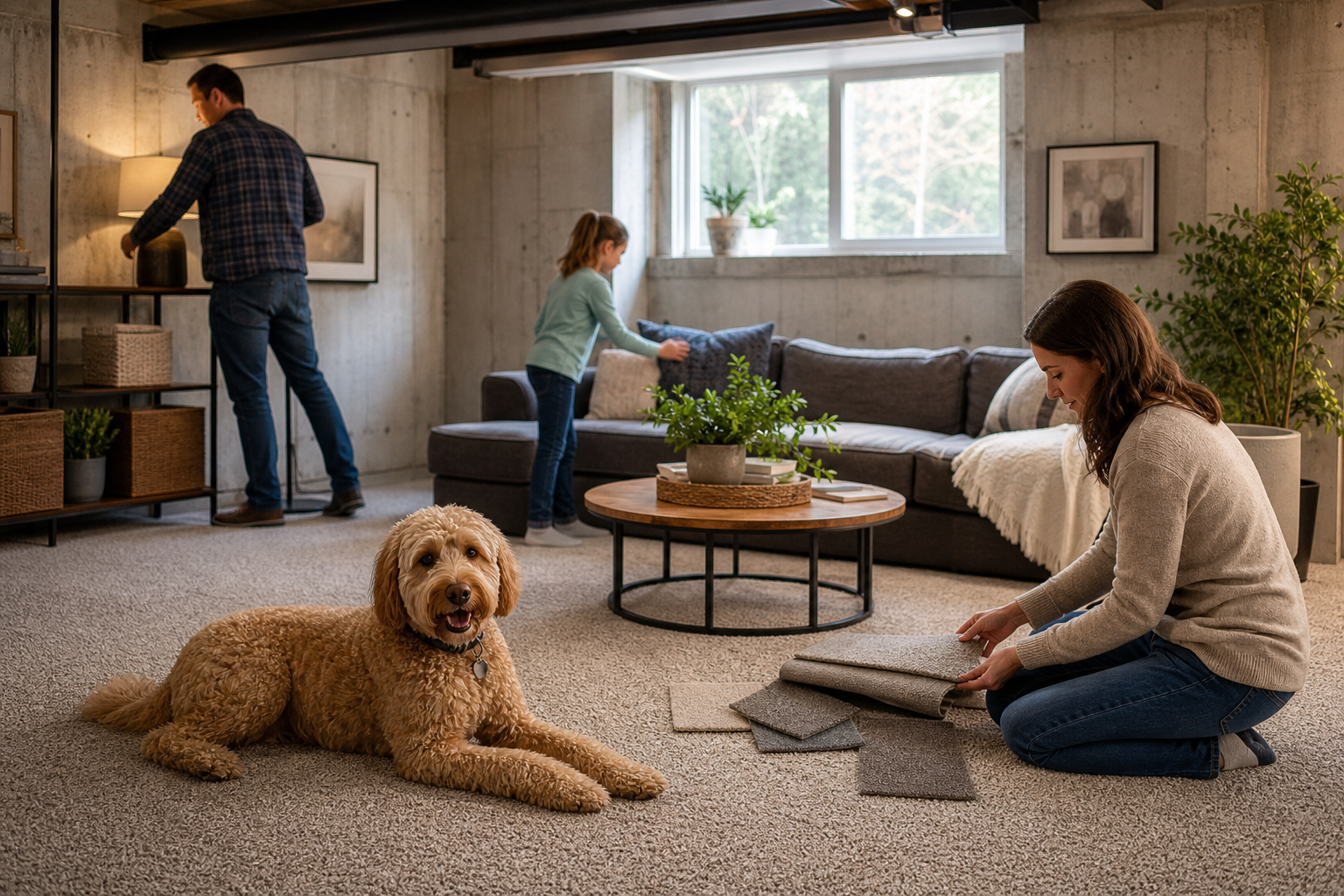
Softest is not best in a basement. The best carpet for basement use is usually a low-pile, dense carpet made with moisture-conscious fiber, paired with the right pad and installed only after the slab and room conditions say the space is dry enough for carpet to make sense.
The best carpet for a basement is typically a low-pile nylon or solution-dyed polyester carpet with a moisture-resistant cushion, not a thick plush style. In Colorado Springs basements, the winning choice is the one that handles below-grade moisture risk, traffic, pets, and concrete subfloors without trapping dampness or matting down fast.
Myth: Basement carpet should be the softest, thickest option you can find because basements run cooler.
Reality: Below grade, thickness can work against you. More pile and the wrong pad can trap moisture, dry slowly, and wear unevenly over concrete. Comfort matters, but basement carpet has to start with moisture control and dense construction.
In Colorado Springs, Colorado and nearby communities like Monument, Falcon, Fountain, and Security-Widefield, I hear this question all the time from homeowners finishing cooler basements. They want warmth underfoot, a quieter room, and something kids can sit on. That all makes sense. But a basement is not the same as an upstairs bedroom, and treating it like one is how people end up replacing carpet earlier than they expected.
I have been in flooring for more than 40 years, and I will tell you this plainly. Basement carpet works well in the right room, with the right product, over the right slab. If any one of those three is wrong, the softest sample in the store will not save the job.
What is the best carpet for a basement?
The best carpet for basement spaces is usually a low-pile, dense carpet made from nylon or solution-dyed polyester, installed with a moisture-resistant pad after the concrete has been checked for moisture. That combination balances comfort, drying ability, wear, and below-grade practicality better than thick plush carpet.
Here is the short list I give homeowners comparing basement carpet samples:
- Low pile or tight loop. Easier to clean, less likely to mat, and less likely to hold dampness.
- Dense face weight and tight construction. Basement family rooms need structure more than fluff.
- Nylon or solution-dyed polyester fiber. Both can be good. Nylon tends to rebound better in traffic. Solution-dyed polyester handles stain concerns well.
- Moisture-conscious pad. A pad can make or break the result more than many shoppers realize.
- Professional moisture testing first. Carpet should go over concrete only when the slab conditions support it.
Weak choice versus strong choice is pretty simple here. A weak choice is a tall, silky saxony with a thick rebond pad over a slab that was never tested. A strong choice is a dense cut pile or low loop with a cushion designed for below-grade conditions, installed after the moisture picture is clear.
The CDC notes that mold grows where moisture is present. That sounds obvious, but it is the whole basement-carpet question in one line. Carpet itself is not automatically the problem. Trapped moisture is the problem.
When does carpet actually make sense in a basement?
Carpet makes sense in a basement when the space stays dry, the use of the room favors warmth and sound control, and the slab has been evaluated before installation. It fits many finished basements well, but it is not the automatic best choice for every below-grade room.
Carpet is usually a smart basement choice for:
- Family rooms and TV rooms
- Basement bedrooms
- Playrooms
- Home offices where sound softening matters
Carpet is usually a poor fit for:
- Basements with a history of seepage, damp smell, or past flooding
- Rooms with exterior doors that track in snowmelt and deicing residue
- Utility-adjacent areas with water heater or drain concerns
- Workout spaces where repeated moisture and odor are harder to manage
Colorado Springs basements often feel cooler because of concrete slabs, lower natural light, and our big day-to-night temperature swings. In Monument and Falcon especially, many finished basements become kid hangouts or guest spaces, so homeowners want softness. That is fine, but the drier Front Range climate does not remove below-grade slab risk, it just makes it easier to underestimate.
EPA guidance on mold and moisture is consistent with what we see in the field. Materials in lower-level spaces need moisture managed first, not after the fact. I have seen perfectly nice carpet blamed for a basement issue that was really a slab or drainage issue from day one.
How dry does a basement need to be before carpet goes in?
Dry enough that the slab and room conditions meet the carpet and cushion manufacturer requirements. If a basement has musty odors, visible efflorescence, damp edges, or a history of water intrusion, I would slow the project down and solve that first.
Signs to pay attention to include:
- White chalky residue on concrete
- Darker damp-looking slab areas
- Baseboard staining
- Condensation near windows or mechanicals
- A dehumidifier running constantly just to keep the room comfortable
Common mistake: judging the basement by how it feels on one dry afternoon
A basement can seem dry in July or during a sunny winter week and still have seasonal moisture movement. I tell homeowners to think in 12-month terms, not 12-hour terms. Snowmelt, summer storms, grading issues, and old crack repairs matter more than the room's feel during one showroom visit.
Which carpet features matter most below grade?
The carpet features that matter most below grade are pile height, density, fiber type, and backing behavior around moisture. The best carpet for basement performance is built to wear cleanly and dry more readily, not simply to feel plush in a sample board.
If you are comparing labels, focus on these traits first:
| Feature | Better for many basements | Usually weaker for basements |
|---|---|---|
| Pile | Low pile, tight loop, dense cut pile | High plush, shaggy texture |
| Fiber | Nylon, solution-dyed polyester | Fiber chosen only for softness |
| Traffic recovery | Strong resilience in family use | Crushes quickly under furniture and play |
| Cleaning | Easier vacuuming and spot cleanup | Traps more dust and pet hair |
Is nylon or polyester better for a basement with pets and kids?
Nylon is often the better all-around performer for active basement spaces because it rebounds well in traffic. Solution-dyed polyester can also be a strong pick if stain resistance is a top concern and the style is dense and low pile.
For pet owners, this matters more than brand names:
- How tightly the carpet is constructed
- Whether claws catch on loop styles
- How easily fur vacuums out
- Whether the product mats in traffic lanes
That is why some families who come in asking for “the softest carpet” leave choosing something firmer and denser. It simply holds up better in a real household. If you are also comparing hard-surface options for busy homes, our piece on Lyrus flooring for busy homes with pets and kids can help you weigh a soft floor against resilient hard-surface performance.
I am not impressed by a basement carpet that looks great for 6 weeks. I care what it looks like after 2 kids, a dog, and a football season worth of traffic.
Should basement carpet be looped or cut pile?
Either can work, but the safer general answer is a low, dense cut pile or a very tight loop selected with pets in mind. Loops can wear well, but in homes with dogs, some loop constructions are more vulnerable to snagging.
If your basement doubles as a movie room and play space, a textured low cut pile is often the middle ground. It feels softer than a commercial-looking loop, but still performs better than a deep plush.
Why can the pad make or break the result?
The pad matters because it affects airflow, drying, support, and how the carpet wears over concrete. A great carpet paired with the wrong cushion can feel nice for a short time and then fail in the exact ways basement owners want to avoid.
Most shoppers spend 90 percent of their attention on the carpet sample and 10 percent on the pad. In a basement, I would flip that thinking. Cushion choice is not a side note.
Look for pad qualities such as:
- Moisture resistance or moisture barrier design, where appropriate
- Firm support that keeps the carpet from flexing too much
- Compatibility with the selected carpet and manufacturer warranty
- Suitability for below-grade installation over concrete
What kind of basement carpet pad usually works best?
A denser, moisture-conscious cushion that is approved for below-grade use usually works best. The exact pad depends on the carpet style, but thick spongy cushion is often the wrong move in a basement.
Two practical points matter here:
- Too much cushion can shorten carpet life. Excessive softness allows movement that wears the backing and face faster.
- The wrong moisture setup can slow drying. If moisture ever reaches the assembly, some pad types handle that event much better than others.
The Carpet and Rug Institute, at Carpet and Rug Institute, offers industry guidance on carpet performance, cleaning, and installation standards. Manufacturer requirements matter here too. The wrong pad can affect warranty coverage, even if the carpet itself was a good choice.
If your basement includes stairs, keep the stair run separate in your thinking. A style that behaves well in the open basement may not be the best choice for the steps. Our guides on the best carpet for stairs that holds up and feels secure and the best carpet for staircases that stays safer and wears longer explain why.
When is LVP or tile the smarter basement option instead?
LVP or tile is the smarter basement option when moisture risk is questionable, exterior access brings in wet shoes, or you simply want easier cleanup than carpet can offer. Carpet is not wrong by default, but there are basements where resilient flooring is the safer call.
Choose LVP or tile first if your basement has:
- A prior water event
- Teenagers and pets coming in from outside often
- A walkout entry exposed to snow, mud, or lawn traffic
- A utility zone near the finished area
- Concerns about allergies or repeated spills
For Colorado Springs homeowners, this comes up often in walkout basements where winter slush and grit get tracked inside. Carpet can still work in a separated TV room or bedroom, while LVP or tile may be the better perimeter or whole-room choice near exterior doors.
LVP is popular because it handles family use well and is easier to wipe clean, but “waterproof” needs plain-English interpretation. It usually means the plank itself resists water damage, not that your whole floor assembly or subfloor is immune to water problems. Tile is still one of the strongest calls in basements with recurring moisture concerns, especially in transition areas. If that is where your project is leaning, our look at Daltile in Colorado Springs for real homes and real wear is a useful comparison point.
Homeowners also compare basement carpet against laminate and hardwood. Solid hardwood is usually not my first recommendation below grade. Engineered products can be more stable than solid wood, but basements still demand caution. If you are weighing wood looks against basement reality, our article on hardwood flooring in Colorado Springs gives the right framework.
How should a Colorado Springs homeowner choose the best carpet for basement use?
Choose the best carpet for basement use by deciding first if carpet belongs there at all, then narrowing to low-pile, dense options with the right cushion and a clear moisture plan. Samples come last, not first.
Basement carpet decision checklist
- Confirm the basement has no active moisture, seepage, or recurring damp smell.
- Ask what moisture testing or slab evaluation is done before install.
- Choose low-pile, dense carpet over thick plush styles.
- Compare nylon and solution-dyed polyester based on traffic and stain priorities.
- Verify the exact pad is approved for below-grade use and for that carpet.
- Think about pets, stairs, and exterior access separately from the main basement room.
- If moisture risk is still a question, compare carpet against LVP or tile before ordering.
That is the clearest path I know. It keeps homeowners from buying basement carpet by feel alone, which is where most mistakes start.
Still deciding on the best carpet for basement spaces?
If you want help sorting out whether carpet is smart for your Colorado Springs basement, and which styles and padding actually make sense below grade, we can walk the space with you and give you a straight answer based on how that room will really be used.
See O'Briens Carpet One Floor & Home