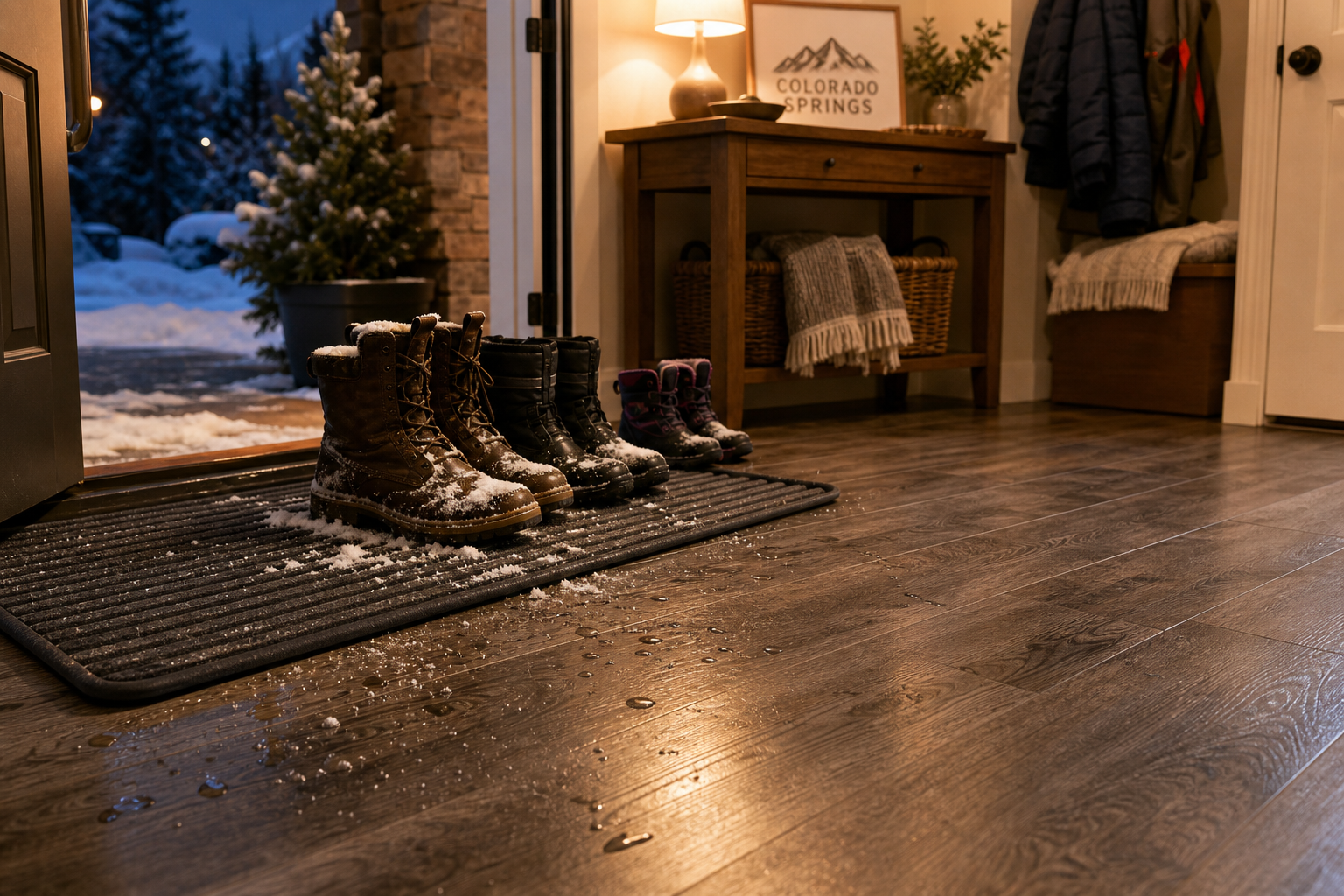
It is 5:30 on a January afternoon in Colorado Springs. The kids come in from school, somebody is still wearing snowy boots from a stop in Monument, and fine deicing grit is already under the mat before anyone notices. That is the real test for laminate flooring for entryway use here, not how it looked under showroom lights for 10 minutes. If a floor is going to survive this spot, it has to deal with snowmelt, abrasive grit, wet seams, and the cleanup habits of a busy household.
Yes, laminate flooring can be a good choice for an entryway with wet or snowy shoes, but only if the specific product is rated for water exposure, has a strong locking joint, and tracked-in snowmelt is cleaned up promptly. In a Colorado Springs entry, success depends less on the word “laminate” and more on the floor’s seam protection, abrasion resistance, and whether the area sees brief moisture or repeated standing water.
Is laminate flooring a good choice for an entryway with wet or snowy shoes?
Yes, sometimes. Laminate flooring for entryway areas can work well in Colorado Springs if you choose a product built for splash and spill resistance, not one that simply looks durable on the sample board. The floor has to tolerate brief wet boot traffic, winter grit, and frequent cleaning, and the household has to wipe up snowmelt before it sits at the joints.
I have been in flooring for more than 40 years, and I can tell you this plainly. An entryway is one of the easiest rooms to buy wrong because people shop it like a hallway and live on it like a mudroom.
Here is the practical standard I use:
- Good candidate: Wet shoes come in, coats get shaken off, the mat catches most moisture, and puddles are wiped up within minutes or at least the same evening.
- Risky candidate: Snowy boots sit on the floor to dry, kids drop gloves in a wet pile, or the dog bowl and the back door activity turn the area into repeated standing water.
- Poor candidate: Melted snow regularly pools along the wall, under a bench, or at a door that leaks.
If your household lives closer to the second or third example all winter, laminate may be the wrong fit for that zone. If it is the first example, a well-chosen laminate flooring for entryway use can hold up just fine.
What does manufacturer water-resistance language actually mean for an entryway?
It usually means protection against spills or wet traffic for a limited time, under specific conditions. It does not automatically mean the whole floor is safe from prolonged standing water, saturated edges, or moisture that gets below the planks. For entryways, the details matter more than the headline claim.
This is where shoppers get tripped up. A carton or display may say “water-resistant” or even use stronger language, but the protection often applies to:
- Top-down moisture exposure only
- A stated time window, often 24, 48, or 72 hours
- Residential use under normal conditions
- Proper installation, including expansion space and approved underlayment
- Prompt cleanup, not neglect
The North American Laminate Flooring Association, NALFA, is one of the organizations tied to laminate performance standards, and its testing framework is a good reminder that performance claims are product-specific, not category-wide. In other words, one laminate is not the same as the next.
A stronger version of the question is not, “Is laminate waterproof?” It is, “What exactly is covered if my family tracks in snow and I miss a wet spot until after dinner?” That answer lives in the warranty and care instructions.
Watch for language about:
- Joint protection. Some laminates use edge coatings, waxed joints, or tighter locking systems that slow water from reaching the core.
- Surface-only warranty. Many claims focus on the wear surface, not damage from water entering seams or the perimeter.
- Excluded conditions. Flooding, plumbing leaks, pet accidents left too long, and standing water are commonly excluded.
If you want a good model for reading flooring warranties like an owner, not a shopper, this piece on what to watch for in a flooring warranty covers the kind of language buyers often miss. Different category, same buyer mistake.
Colorado Springs homes see a particular winter pattern. Snow can melt off boots quickly in a heated house, then dry out fast in our low humidity, which sounds helpful but actually makes it easier to overlook grit and moisture at the seams. I see this a lot in family homes from Briargate to Fountain, where the front entry gets hard use during school and work drop-offs.
How do snow, grit, and winter footwear wear on laminate in Colorado Springs?
Grit is often the bigger long-term problem than the water. Snowmelt can swell a vulnerable joint if it sits too long, but the fine sand, deicer, and rock fragments tracked in from sidewalks and driveways are what steadily grind away at the finish if they are not removed often.
Colorado entryways are rough on floors because they deal with two wear types at once:
- Moisture event: A burst of wet boots and melting snow.
- Abrasive event: Fine grit trapped under soles and dragged back and forth.
The U.S. Environmental Protection Agency has long noted that walk-off mats can capture a large share of tracked-in soil before it reaches interior floors. That matters because abrasion is cumulative. A few grains of deicer under a boot heel, repeated hundreds of times over 1 winter, do more damage than most people think.
This is why I tell families to look beyond color and plank width and ask these 4 product questions:
Entryway laminate checklist
- What is the wear rating or abrasion performance level for this exact laminate?
- Does the locking system include sealed, treated, or waxed joints?
- What does the manufacturer require for wet cleanup, and how fast?
- Does the warranty mention entryways, mudrooms, or standing water exclusions?
- What kind of mat is allowed, and are rubber or non-ventilated backings restricted?
A weak approach is buying the cheapest laminate on the wall because the sample feels hard and the photo shows a front door vignette. A stronger approach is choosing a product with documented water-resistance language, a proven locking profile, and a wear layer intended for active family traffic.
Most floor failures are not mystery failures. They are mismatch failures.
What kind of mat helps, and can the wrong mat cause problems?
Mats help a lot, but they need to match the floor and the traffic pattern. A good mat system reduces both moisture and grit before they reach the laminate. The wrong backing or a mat that traps water against the planks can create its own issue.
For laminate flooring for entryway performance, I usually recommend a 2-part approach:
- Outdoor scraper mat. This knocks off larger grit and packed snow before people step inside.
- Indoor absorbent mat. This catches the moisture and finer debris the first mat misses.
Check the floor care instructions before buying mats. Some manufacturers caution against certain rubber or latex backings if they can trap moisture or discolor the floor. You also want a mat that lies flat and does not create a trip edge at the door swing.
Look for:
- Breathable or floor-compatible backing
- Enough length for 2 to 3 steps across the surface
- Regular cleaning so the mat does not become a grit reservoir
And here is the part people skip. Lift the mat and dry under it. If the mat catches all the mess but stays damp against the same plank edges for 12 hours at a time, you have only moved the problem.
The common mistake I see in snowy entries
Homeowners think the mat solved it, so nobody checks underneath. Then the floor starts to show edge swelling right where the mat ends or where moisture sat under the backing. The mat should reduce exposure, not hide it.
How quickly does snowmelt need to be cleaned up on laminate?
Quickly. For a busy family, “promptly” should mean right away when you notice it, not tomorrow morning. The longer meltwater sits at plank joints and perimeter gaps, the more chance it has to work into the core or under the floor.
Here is a practical cleanup routine for a Colorado Springs household:
- Shake off boots on the exterior mat.
- Use the interior mat as the boot landing zone.
- Check the floor within 10 to 30 minutes after the main wave of arrivals.
- Dry visible water with a towel or microfiber mop.
- Vacuum or sweep grit the same day, because grinding damage starts immediately.
The National Wood Flooring Association, NWFA, focuses on wood floors rather than laminate, but its core moisture warning applies here too. Water left at joints and edges is where trouble starts. Different material, same basic rule about standing moisture around seams.
If your entry is used 6, 8, or 10 times on a snowy day, that cleanup routine matters more than one extra marketing layer in the product brochure.
When does an entryway exceed laminate’s fit?
An entryway exceeds laminate’s fit when the space sees repeated standing water, chronic wet gear piles, door leaks, or a mudroom level of daily soak-and-dry use. At that point, you are no longer asking laminate to handle tracked-in moisture. You are asking it to tolerate routine pooling, and that is a different job.
Here are the signs I would steer a Colorado Springs buyer away from laminate for that zone:
- Snowy boots are regularly left to drip on the floor for hours.
- A bench, tray, or cubby area traps puddles.
- The exterior door lets in wind-driven moisture.
- Pets come through the same door wet and sandy several times a day.
- The entry blends into a laundry or utility area where spills are common.
That is where another flooring category may simply be more appropriate. If you are weighing harder-wearing water-tolerant choices, our guides to tile flooring in Colorado Springs and what to know before buying vinyl plank locally can help you compare by use case, not marketing language.
My rule is simple. If the room behaves like a mudroom, shop it like a mudroom.
John Hughes's Insights
I have watched a lot of Colorado families buy entry floors over the years, and the best outcomes usually come from honest expectations, not flashy labels. If you tell me your kids dump snow-covered boots by the door, the dog runs in with sandy paws, and nobody wants to babysit the floor every evening, I am not doing you a favor by pretending every laminate will handle that the same way. Some will do well. Some will not.
What I tell my own customers in Colorado Springs is this. Bring me the real story, not the ideal story. Tell me how your family actually comes through that door in January. Tell me if wet shoes sit there for 2 hours. Tell me if the front entry is more of a drop zone than a formal foyer. Good flooring advice starts there, and that is how you avoid paying twice.
Frequently Asked Questions
How many times can I expect to wipe up winter moisture in a Colorado Springs entry?
On active snow days, many families will check the area 2 to 4 times between school pickup and bedtime. The exact number matters less than having a routine. Quick wipe-ups and same-day grit removal give laminate its best chance in an entryway.
Can laminate flooring for entryway areas be installed over concrete near a front door?
Yes, many laminate products can be installed over concrete, but the slab has to be properly tested and prepped for moisture first. In Colorado, I would not skip that step. Subfloor moisture problems can ruin a good product choice, and a proper measure should catch that before installation.
Do I have to move furniture and entry benches before installation?
Usually, yes, the area needs to be cleared unless your installer has arranged otherwise. If you are planning the job now, this guide on what to move before flooring installation day will help you avoid last-minute surprises.
Need help choosing the right floor for a snowy Colorado Springs entry?
If you want someone to sort through the water-resistance claims, inspect the entry conditions, and tell you plainly whether laminate flooring for entryway use makes sense in your home, we can handle that for you. Book a free in-home flooring measure and consultation with O'Briens Carpet One Floor & Home, and we will evaluate the room the way it actually gets used.
Book your free in-home measure and consultationExplore more, or reach out directly to O'Briens Carpet One Floor & Home in Colorado Springs, CO.