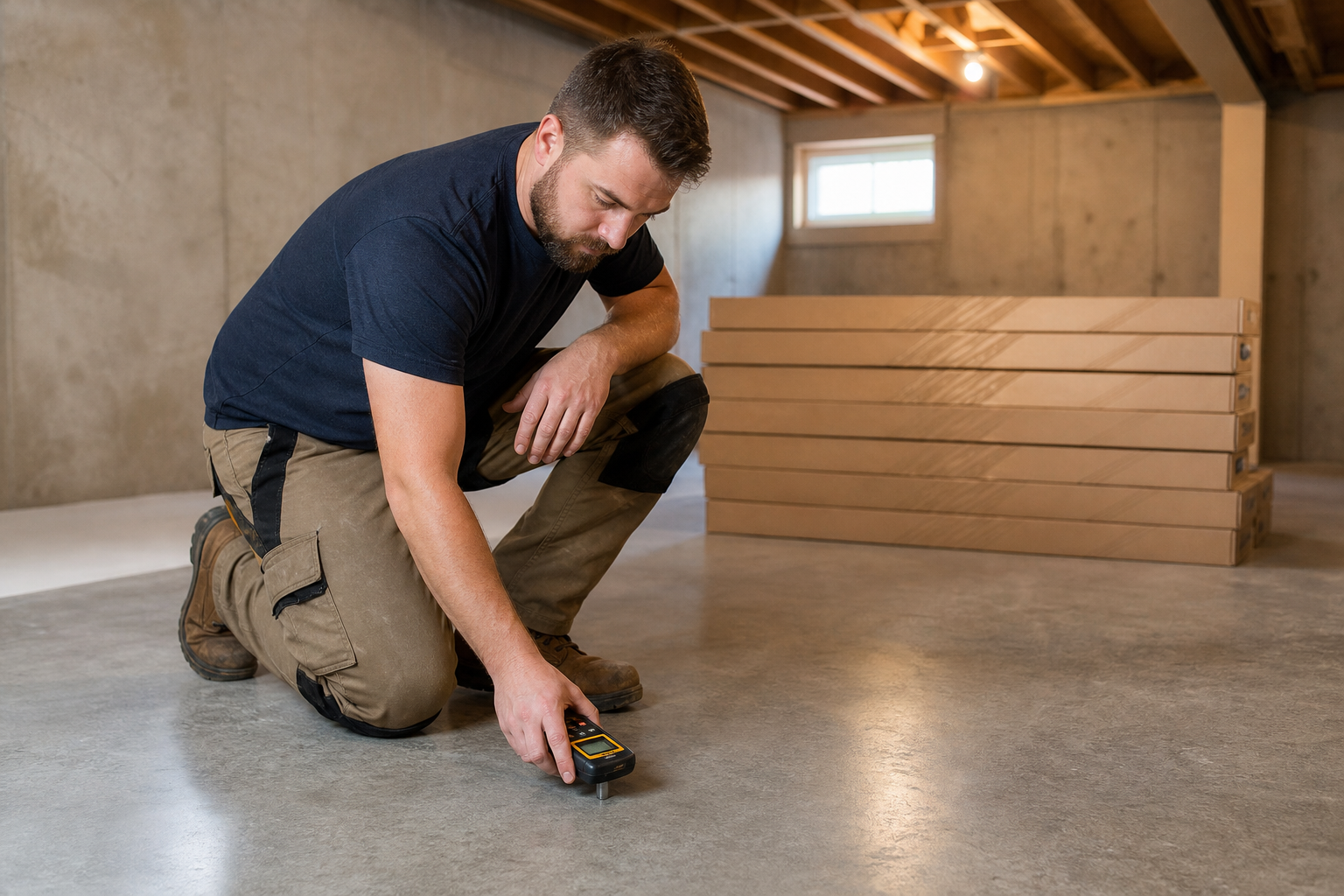
A basement slab can fool you. In Colorado Springs, I have seen concrete look clean, hard, and bone dry on the surface, then fail a moisture test that would have put a new floor and its adhesive at risk. That is why concrete moisture testing before flooring matters. It checks a hidden installation condition homeowners cannot judge by sight, and it gives the project a clear yes, no, or not yet before materials go down.
Yes, a concrete basement floor often needs moisture testing before new flooring is installed. A slab can hold or transmit moisture even when the surface looks dry, and flooring manufacturers usually spell out which test methods and moisture limits apply to their products, adhesives, and underlayments. Testing before installation helps catch a problem early, while the plan can still be adjusted.
Does a concrete basement floor need moisture testing before new flooring is installed?
Yes. If new flooring is going over a basement slab or slab-on-grade concrete, moisture testing is often the only reliable way to verify whether the slab is within the flooring manufacturer's limits. Looking at the surface is not enough, and a dry-looking floor does not prove the slab is ready.
This is the question I wish more remodelers asked at the start of a Colorado Springs basement renovation instead of after a floor starts to cup, release, or telegraph adhesive problems. The answer comes down to 3 things:
- Concrete can store moisture deep in the slab.
- Concrete can also transmit moisture vapor upward from below.
- The flooring system being installed decides what test is required and what result is acceptable.
The Portland Cement Association, through Portland Cement Association, has long noted that concrete can appear dry while still containing enough internal moisture to affect finishes. The ASTM International standards used across the flooring trade exist for exactly that reason. In practical terms, concrete moisture testing before flooring is not busywork. It is part of installation readiness.
I have been in this trade for more than 40 years, and I can tell you this plainly. A slab does not care what it looks like on top. It only cares what is happening inside it and under it.
Why can concrete look dry and still have too much moisture for flooring?
Because surface dryness and internal slab moisture are not the same thing. The top of the slab may feel dry to your hand, while moisture remains deeper in the concrete or moves upward as vapor from the ground side. Flooring failure can start from that hidden moisture, not from puddles or visible dampness.
Concrete is porous. It absorbs, holds, and releases moisture over time. In a basement, that matters because the slab is in contact with a below-grade environment, and in slab-on-grade areas it matters because moisture conditions below the slab still influence what happens above it.
There are 2 separate moisture issues homeowners tend to lump together:
- Visible water intrusion. This is the obvious problem. Water entering through foundation walls, cracks, window wells, snowmelt paths, or plumbing issues. You may see staining, puddling, damp base edges, or active leaks.
- Slab moisture or vapor transmission. This is the hidden problem. No standing water. No obvious wet spots. Yet the slab still tests above the limits for the floor being installed.
Those are not the same diagnosis, and they are not solved the same way. A basement can have no active leak and still fail moisture requirements for glue-down LVP, engineered wood, or certain tile setting materials. In Colorado Springs, our dry air tricks people into assuming the slab is dry too. Indoor air at altitude can feel crisp, but the concrete below your feet follows its own moisture cycle.
Colorado Springs basements and slab-on-grade rooms in places like Monument, Falcon, Fountain, and Security-Widefield often see big seasonal swings. Snowmelt outside, spring moisture, irrigation near the foundation, and temperature changes between heated interiors and cool concrete all affect what a slab is doing, even if the room itself feels dry.
What does concrete moisture testing before flooring actually establish?
It establishes whether the slab meets the manufacturer's moisture requirements for the planned installation system. That means the test is not just looking for wetness. It is measuring conditions that help predict whether the flooring, adhesive, or underlayment will perform as intended after installation.
The 2 testing approaches homeowners hear about most often are:
- In situ relative humidity testing. This measures internal slab moisture conditions using probes placed in the concrete. ASTM F2170 is the standard commonly referenced for this method.
- Calcium chloride testing. This measures moisture vapor emission rate at the slab surface. ASTM F1869 is the standard commonly referenced for this method.
Manufacturers do not all ask for the same thing. Some accept one test method. Some allow either of the 2. Some specify different limits depending on which adhesive, patch, self-leveler, or moisture mitigation product is being used.
To make that concrete, here is the difference between a weak assumption and a stronger installation decision:
| Weaker approach | Stronger approach |
|---|---|
| "The slab looks dry, so let's install the floor." | "The slab tested within the manufacturer's limits for this exact flooring and adhesive system." |
| "A neighbor used the same product in a basement and it was fine." | "This basement's slab was tested, documented, and matched to the approved installation requirements." |
FCICA, the Flooring Contractors Association, and the Resilient Floor Covering Institute both emphasize substrate readiness and manufacturer instructions because resilient floors and adhesives are only as dependable as the slab conditions underneath them.
I would rather slow a job down for 1 day than explain a preventable problem 6 months later.
Why do the flooring and adhesive system determine the moisture requirements?
Because floors do not go onto concrete by themselves. The complete assembly matters. A floating floor, a glue-down vinyl product, a tile installation, and an engineered wood system can all react differently to the same slab. The adhesive can be the limiting factor just as much as the floor itself.
Here is why the intended system matters so much:
- Glue-down products depend on adhesive performance. If slab moisture is too high for the adhesive, bond failure, softening, or staining can follow.
- Wood-based products react to moisture differently than tile. Engineered wood over concrete often has tighter substrate requirements than many homeowners expect.
- Underlayments and patch materials have their own limits. The floor may allow one range, but the prep materials beneath it may allow less.
- Some systems require additional moisture control measures. That could mean a moisture mitigation coating, a specific primer, or a different adhesive line.
This is one reason basement product selection is not just about color, plank width, or price per square foot. If you are deciding between carpet, laminate, LVP, tile, or engineered wood for a below-grade room, the slab can narrow the options fast. If you are also weighing comfort and practicality, our article on the best carpet for a basement that stays comfortable and practical covers a different side of that decision. If you are comparing resilient floors for active households, our look at Lyrus flooring for busy homes with pets and kids helps with product fit, but the slab still has to qualify first.
What to confirm before basement flooring is approved for installation
- The exact flooring product name and construction.
- The exact adhesive, if the system is glue-down.
- The manufacturer-approved moisture test method.
- The acceptable moisture limit for that product and system.
- Whether patch, leveler, or moisture mitigation materials add separate requirements.
- How the test results will be documented before installation proceeds.
What happens if the slab fails the moisture test?
A failed test does not always kill the project, but it usually changes the plan before installation proceeds. That is the point of testing. It gives the crew and the homeowner a chance to correct the substrate condition, change materials, or delay installation before finished flooring is at risk.
The next step depends on what failed and by how much. Common outcomes include:
- Pause the job and investigate the cause. If there are signs of actual intrusion, the source has to be addressed first.
- Change the prep system. A moisture mitigation product or different underlayment may be needed if the manufacturer allows it.
- Change the adhesive. Some adhesive lines are approved for different moisture ranges.
- Change the flooring category. A product more compatible with the slab conditions may be the better choice.
- Wait and retest. In some projects, the slab simply is not ready yet.
That is the technical preparation that protects the project. It is not dramatic, and it does not always show in the finished room photos, but it is often the difference between a floor that performs and one that starts showing trouble early.
If you are choosing tile for a basement bath, mudroom, or lower-level bar area, the slab prep discussion also connects to product performance. Our article on Daltile in Colorado Springs for real homes and real wear gets into how tile choices fit actual household use, but even tile assemblies still depend on proper substrate conditions.
A common mistake I see in basement remodels
Homeowners fixate on visible dryness and skip the invisible condition underneath. A slab can pass the hand test, the eye test, and the "it has been dry for years" test, then still miss the flooring manufacturer's requirement. Concrete moisture testing before flooring catches that mismatch before material, labor, and scheduling get more expensive.
How does this play out in a Colorado Springs basement renovation?
In a Colorado Springs basement renovation, the local climate often creates false confidence. Dry air, sunny weather, and a clean slab surface make people think moisture is not an issue. But below-grade concrete and slab-on-grade areas around El Paso County still need to be judged by test data, not appearance.
Here is a realistic local scenario. A homeowner is finishing a basement family room on the north side of Colorado Springs. The concrete has no visible puddling, no musty smell, and no dark staining. They want glue-down LVP because they have 2 kids, 1 dog, and a budget that has already stretched across paint, trim, and lighting. The room looks ready. Then the moisture test shows the slab is above the allowable range for the selected adhesive. At that point, one of 3 things usually happens:
- The prep plan changes to include an approved moisture control step.
- The adhesive line changes, if the manufacturer permits it.
- The product selection changes to a system better suited to the slab condition.
That is a good catch, not a setback. It is a subfloor problem caught before it ruins the floor. In a dry-climate market like ours, that kind of behind-the-scenes work matters because homeowners often never see the risk coming.
If you are comparing local stores and wondering what real full-service preparation includes, our article on what full service flooring means for Colorado Springs homes speaks to the difference between just selling material and actually preparing a job correctly.
"A dry-looking slab is not the same thing as a slab that meets the flooring manufacturer's moisture limits. I would much rather prove a floor is ready than hope it is." John Hughes
Frequently Asked Questions
Can a basement have no leaks and still fail moisture testing?
Yes. A basement can show no visible leaks, no puddles, and no damp smell, yet still fail because the slab contains internal moisture or transmits moisture vapor at a level above the flooring system's limit. Visible water intrusion and slab moisture are related topics, but they are not the same condition.
Is moisture testing only important for wood floors?
No. Moisture testing matters for many basement flooring systems, including glue-down vinyl, engineered wood, laminate systems over concrete, and even tile assemblies when associated setting or prep materials have moisture limits. The correct question is not "Is this floor waterproof?" It is "What does this floor and adhesive system require from the slab before installation?"
See how we document concrete moisture testing before flooring
If you are planning a Colorado Springs basement or slab-on-grade flooring project, we can show you how the substrate is checked, what the product requirements actually say, and how test results can change the prep or product plan before installation starts. That is the kind of behind-the-scenes work that protects the floor you pay for. Visit O'Briens Carpet One Floor & Home to book a free in-home flooring measure and consultation with a local Colorado Springs flooring expert.
Book your free in-home flooring measure and consultation